Case Study · Medical AI · MLOps Platform
Medical AI MLOps Platform
End-to-end Medical AI platform for chest X-ray classification, combining GPU training, MLflow experiment tracking, model registry management, Apache Airflow orchestration, Kubernetes deployment and monitoring.
Project Snapshot
Domain
Medical AI
Training
RunPod RTX4090
Orchestration
Apache Airflow
MLOps
MLflow + Registry
Deployment
FastAPI + Kubernetes
Monitoring
Prometheus + Grafana
Platform
Medical AI MLOps
End-to-end platform for training, tracking, registry, deployment and monitoring.
Orchestration
Apache Airflow
Automated DAG workflow for validation, tracking, registry checks and champion promotion.
Training
RunPod RTX4090
GPU-based ResNet50 training for chest X-ray classification.
Deployment
Kubernetes + FastAPI
Containerized inference service with monitoring and operational readiness.
Medical AI Challenge
Medical image classification requires robust preprocessing, reliable evaluation and explainable predictions that can be interpreted beyond raw confidence scores.
Deep Learning Solution
The project combines a custom CNN baseline with transfer learning architectures and Grad-CAM explainability for transparent model behavior.
Portfolio Outcome
A complete medical AI showcase connecting training, model comparison, explainability and a user-facing inference demo.
Solution Overview
From image classification to explainable AI demo
The project demonstrates a complete deep learning workflow for chest X-ray classification: image preprocessing, model training, transfer learning comparison, evaluation, explainability and an interactive demo interface. The focus is not only prediction accuracy, but also interpretability and presentation-readiness.
Architecture Flow
Medical AI workflow
Dataset
Airflow
GPU Training
MLflow
Registry
Promotion
FastAPI
Kubernetes
Monitoring
The pipeline connects raw medical images with model training, evaluation, explainability and an interactive inference demo — the core ingredients for a credible applied computer vision showcase.
Model Lifecycle
From X-ray images to explainable prediction
Prepare Images
Chest X-ray images are loaded, transformed and normalized for model training.
Train Models
A custom CNN baseline is compared with transfer learning architectures.
Evaluate Results
Training curves, validation behavior and model comparison guide final model selection.
Explain & Demo
Grad-CAM and Streamlit connect prediction output with visual interpretation.
Screenshots
Platform interface and implementation evidence
The screenshots show the project overview, inference demo, Grad-CAM explainability, model comparison and training curves.
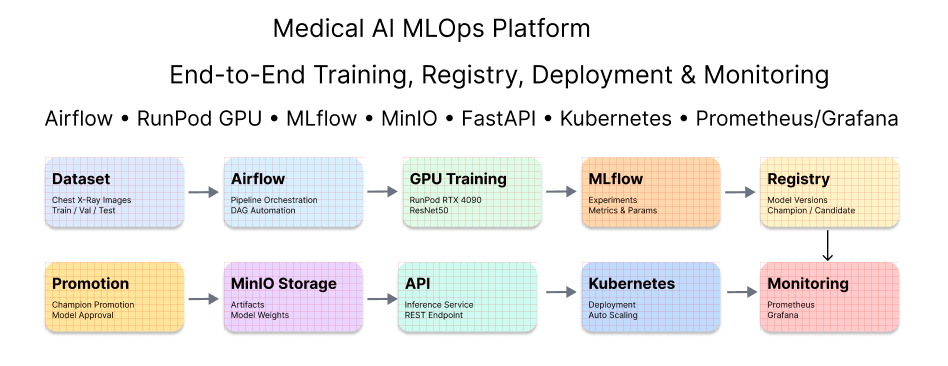
MLOps Platform Architecture
End-to-end Medical AI MLOps architecture with Airflow, RunPod GPU training, MLflow, MinIO, FastAPI, Kubernetes and monitoring.
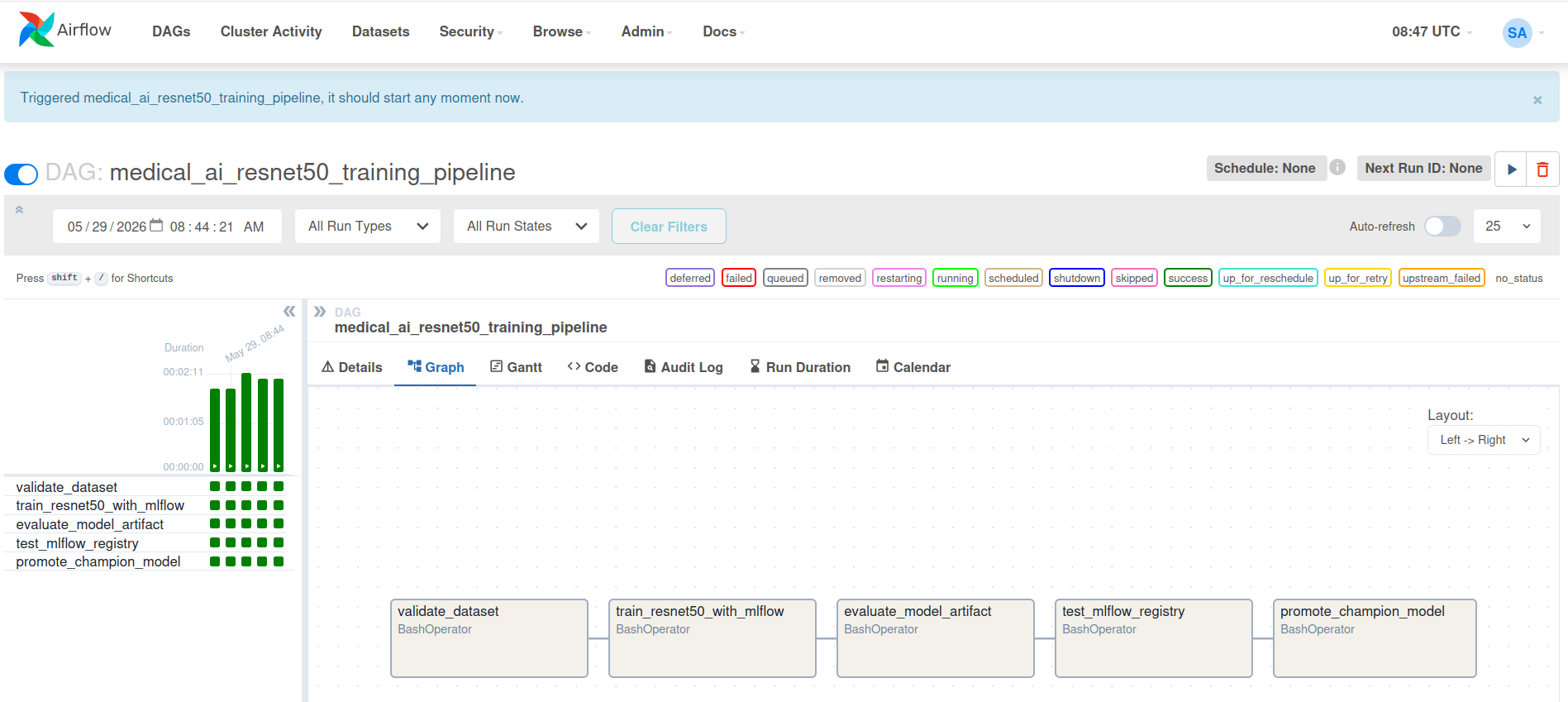
Airflow Orchestration
Successful end-to-end Airflow DAG covering dataset validation, training workflow, MLflow registry validation and champion promotion.
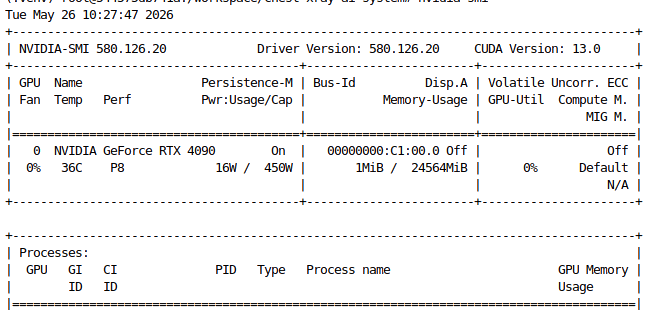
RunPod RTX4090 Training
GPU-based ResNet50 training executed on RunPod RTX4090 for scalable medical image model development.
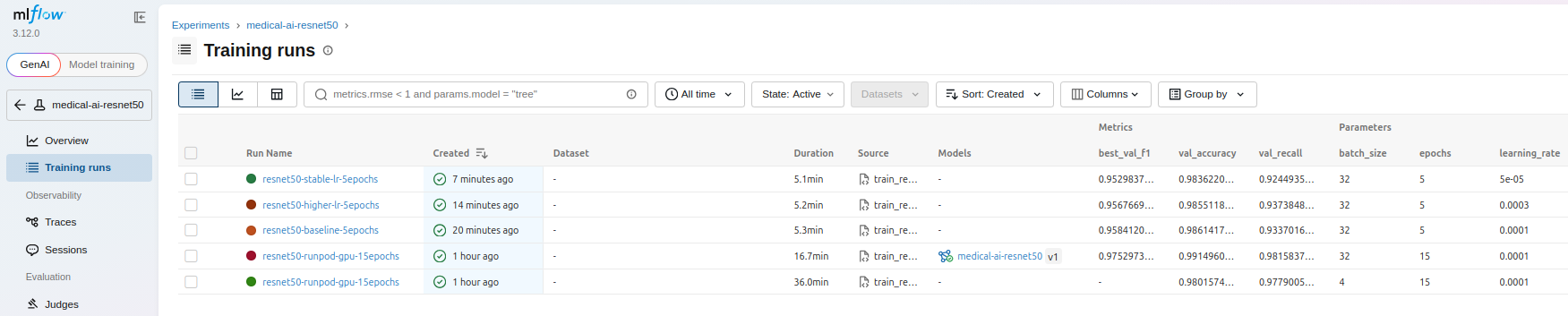
MLflow Experiment Tracking
MLflow experiment comparison with logged metrics, parameters and training runs.
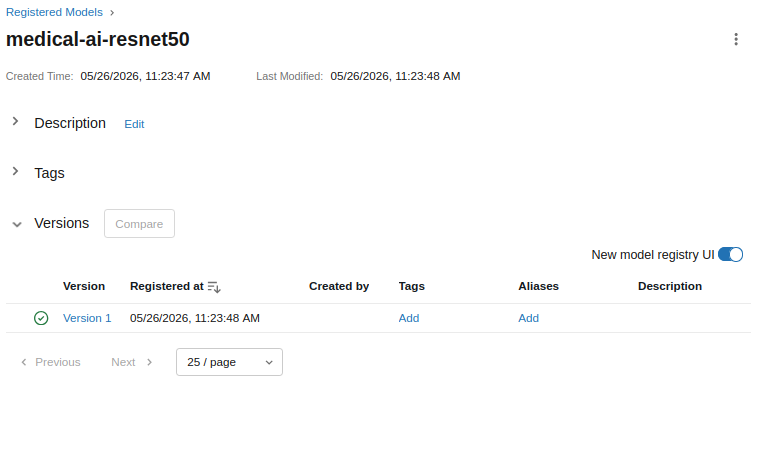
MLflow Model Registry
Model lifecycle management with registered versions, candidate models and champion selection.
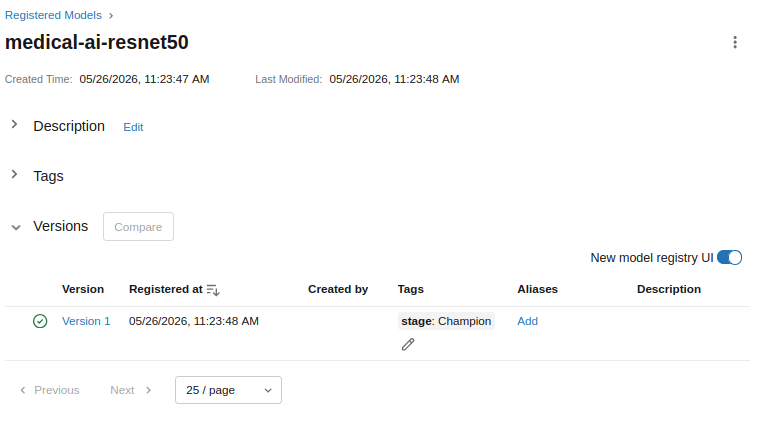
Champion Model
Champion model workflow for controlled promotion and deployment readiness.
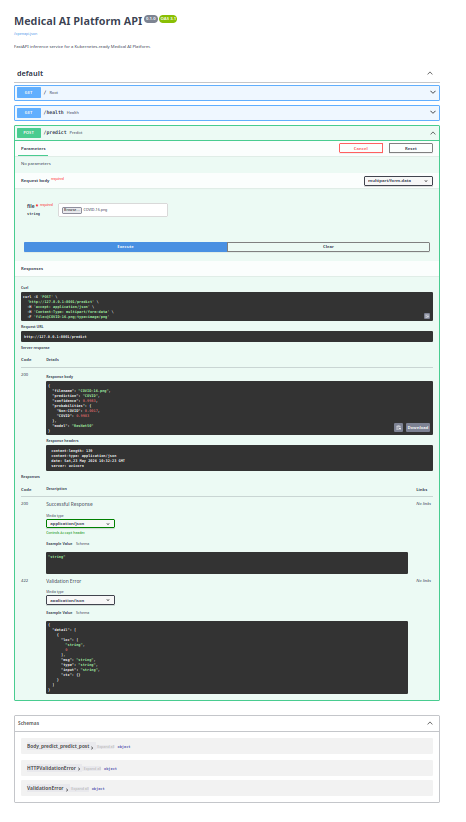
FastAPI Inference
REST API endpoint for serving the medical AI model as a containerized inference service.
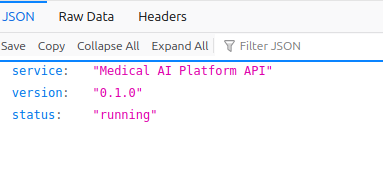
Kubernetes Deployment
Containerized API deployment running on Kubernetes with service exposure and scaling readiness.

Monitoring Stack
Prometheus and Grafana monitoring stack for operational visibility.
Deep Learning Pipeline
Training, comparison and explainability
Model Development
CNN and transfer learning benchmark
The project compares baseline CNN modeling with transfer learning architectures such as ResNet and DenseNet. This demonstrates practical model selection and evaluation for computer vision workflows.
Deployment / Inference
Interactive Streamlit demo
The inference layer allows users to test example X-ray images, view model confidence and demonstrate how the model behaves in a controlled presentation environment.
Explainability
Grad-CAM turns prediction into visual evidence
Prediction
The system produces a classification result with confidence information.
Visual Attention
Grad-CAM highlights image regions that contributed to the model decision.
Human Review
The output is presented as decision support and explainability evidence, not as a standalone clinical diagnosis.
Grad-CAM helps communicate which image areas influenced the model decision. This makes the demo more transparent and shows awareness of responsible AI principles in sensitive domains.
Business / Clinical Value
Why this project matters
This project is presented as a technical AI engineering showcase and decision-support prototype, not as a certified medical device or standalone diagnostic system.
Technologies
Implemented stack
Medical AI · Computer Vision · Explainability
Need an explainable AI demo or computer vision prototype?
MSC Intelligent Systems builds AI prototypes that connect model development with usable demos, evaluation, explainability and deployment-oriented architecture.